

The Power of Place
In 2022, Hudson Valley Shakespeare moved from its longtime site at Boscobel House and Gardens to a 98-acre property in Philipstown provided by philanthropist Chris Davis as a permanent home for the non-profit theater company.
With a focus on ecological restoration and climate-smart investment in green design, the new campus is unique in the wider cultural landscape of the American Theater, bringing together cultural placemaking, community engagement, and environmental sustainability onto one spectacular site.
Designed by the renowned architecture and urban design practice Studio Gang, the 14,850-square-foot venue is protected from the elements yet open to the landscape, accommodating a performance season from June through September. Construction began on September 25, 2024, with Consigli Construction Co., Inc. serving as Construction Manager, and the theater is set to welcome audiences in summer 2026.
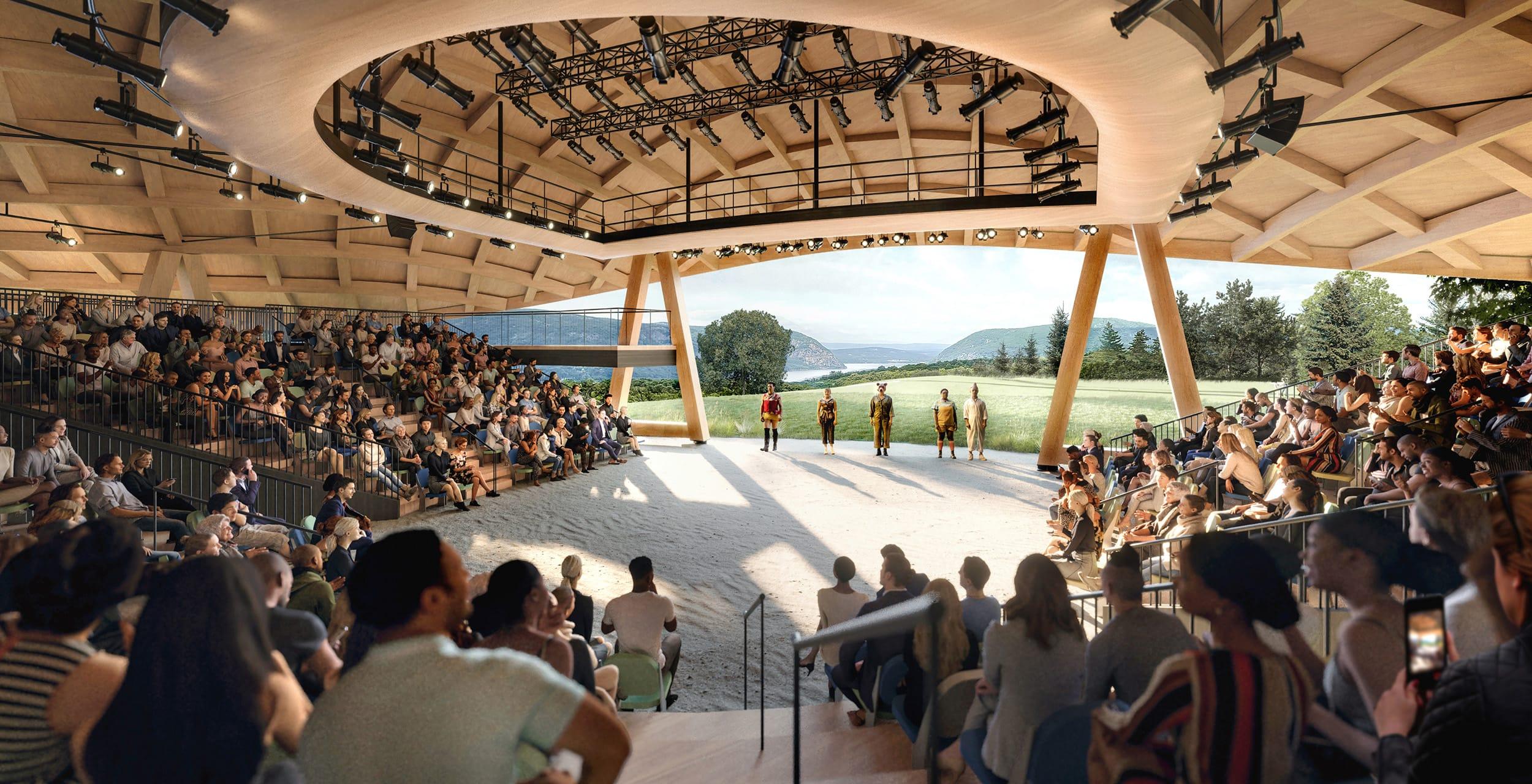
At the heart of the campus is a 6,800-square-foot, 480-seat open-air theater, whose curved timber-framed grid shell and columns rise naturally from the land, creating a dialogue with the Hudson Highlands. The stage’s proscenium arch is carefully oriented to frame iconic views of the Wey-Gat (“Wind Gate”) of Storm King Mountain, the Hudson River, and Breakneck Ridge, allowing performers to emerge directly from the surrounding topography. Anchored by the theater, a series of thoughtfully designed pavilions—including rehearsal studios, a costume shop, teaching and education spaces, artist accommodations, administrative offices, concessions, and public amenities—are clad in natural materials that reflect the region’s character. Outdoor gathering areas, picnic lawns, and a scenic overlook invite visitors to linger before and after performances in an extraordinary natural setting.
Guided by a deep commitment to sustainability and responsible stewardship of land conveyed to the company by philanthropist and conservationist Christopher Davis, the Scripps Theater Center aspires to be the first purpose-built LEED Platinum theater in the United States. The comprehensive campus design, led by landscape architects Nelson Byrd Woltz, emphasizes ecological restoration, rewilding, and climate-smart investment, with features such as natural ventilation, low–embodied carbon materials, brise soleil systems, rooftop solar panels, and expansive green space. With wildflower gardens, native meadows, walking trails, a restaurant with sweeping river views, and a public commitment to carbon neutrality by 2040, Hudson Valley Shakespeare is creating a cultural destination that places both art and the environment center stage for generations to come.

The Design
Conceived as a single, fluid gesture—like the wing of a bird—the theater design encompasses the theater’s disparate functions, vastly improving circulation between spaces and across the site and enabling a wider range of cultural and community programming.
A-frame columns mark entrances into the theater and support the curved grid-shell shade structure.
The stage’s proscenium arch serves as an entrance for patrons and actors, while shading them from the sun during dusk performances.
Encouraging visitors to meander through the landscape, restored native grasses frame a variety of verdant paths across the site, while increasing the region’s biodiversity.
Picnic lawns on the hill around the theater encourage visitors to gather before and after shows to enjoy sweeping views.
The landscape is designed as an experiential sequence: upon arrival to a new, gravel parking area, visitors encounter a mix of unpaved and accessible paths that guide them up and through native meadows, ultimately leading to the hilltop theater and gathering areas. A large portion of the site has deliberately been left open for future walking trails or other community uses, while picnic lawns, shaded by new native trees, offer an abundance of vantage points from which to take in the view and enjoy pre-show activities.
Samuel H. Scripps
Hudson Valley Shakespeare's first permanent home is named in honor of Samuel H. Scripps (1927-2007), a visionary philanthropist whose passion for theater and dance profoundly shaped American culture.From an early age, Sam developed a deep love for Shakespeare, which would guide his lifelong commitment to the arts. With his wife, Luise Elcanness Scripps (1927-2015), Sam played a pivotal role in promoting and supporting dance and theater across the United States and around the globe. Hudson Valley Shakespeare is deeply honored to name our theater in Sam’s memory, in recognition of his and Luise’s lifelong enthusiasm for Shakespeare, and their devotion to the artistic community of the Hudson Valley region.
A Home for Artists
Artist Lodging
As part of the expansive new campus,construction is also underway for on-site lodging for its artists, designed by award-winning architect Susan T. Rodriguez. The lodging, envisioned as a small village of residences and shared spaces nestled within the company’s 98-acre campus, will be located just a short walk, bike ride, or golf cart trip from the theater and the Rehearsal Studios (opened in 2022), and is inspired by the timber-frame traditions of Hudson Valley architecture. Plans include a barn-like structure housing 16 single-occupancy studio apartments, along with four four-bedroom cottages designed to accommodate families and groups of artists.
Anchoring the village is a communal hub connected to the main barn building, creating a welcoming place for artists to gather, recharge, and connect. This shared space will include laundry and exercise facilities, as well as comfortable areas for meals, conversation, and relaxation—supporting the rhythms of an intensive rehearsal and performance schedule while fostering a strong sense of company life.
More than simply a place to stay, the artist lodging reflects HVS’s commitment to the health, well-being, and creative vitality of its artists. By living and working together in the natural beauty of the Hudson Highlands, artists will have the opportunity to form a thriving creative community, supporting one another onstage and off across a season—or many seasons. The lodging will also support off-season residencies and retreats, helping incubate future work, while generating meaningful operational benefits, including an estimated $500,000 in annual cost savings and new opportunities for off-season rental income.
Design Team
Architect Jeanne Gang
Jeanne Gang (she/her), FAIA, is the founding partner of Studio Gang. Her inquisitive, forward-looking approach to design—unique in its pursuit of new technical and material possibilities as well as in its expansion of the active role of designers in society—has distinguished her as a leading architect of her generation. Drawing insight from ecological systems, she creates striking places that connect people with each other, their communities, and the environment.
Her diverse, award-winning portfolio includes cultural centers that convene diverse audiences, public projects that connect citizens with ecology, installations that challenge traditional material properties, and high-rise towers that foster community. Notable among these are the recently completed Richard Gilder Center for Science, Education, and Innovation at the American Museum of Natural History in New York, which the New York Times called “a poetic, joyful, theatrical work of public architecture and a highly sophisticated flight of sculptural fantasy.” Other completed projects include the reimagined Arkansas Museum of Fine Arts in Little Rock; Writers Theatre, a professional theater in Glencoe, Illinois; the Arcus Center for Social Justice Leadership at Kalamazoo College in Kalamazoo, Michigan; and two towers that have redefined Chicago’s skyline: the 101-story St. Regis Chicago, now the city’s third-tallest building, and the 82-story, undulating Aqua Tower. Her ongoing work includes major cultural and civic projects throughout the Americas and Europe, such as a new United States Embassy in Brasília; the University of Chicago’s European hub for study and research in Paris; Stanford University’s new Sustainability Commons in Palo Alto; and an expansion of the Clinton Presidential Center in Little Rock. Tall buildings in Toronto, Denver, Paris, and Boston are also underway. Intertwined with built work, Jeanne and the Studio also develop research, publications, and exhibitions that push design’s ability to create public awareness and give rise to change—a practice Jeanne calls “actionable idealism.” The Studio has championed innovative design strategies to improve ecological biodiversity in cities, including bird-safe building techniques and an experimental prairie ecosystem on the rooftop of their Chicago office. At the same time, Jeanne has challenged the status quo in professional practice by closing the gender wage gap in her company and encouraging her colleagues to follow suit. Jeanne is a Professor in Practice at the Harvard Graduate School of Design, her alma mater, where her teaching and research focus on the cultural and environmental aspects of buildings’ reuse. She is the author of four books on architecture. Her most recent book, The Art of Architectural Grafting, was released this spring in both French and English editions. Her work has been exhibited widely, including at the Museum of Modern Art, the International Venice Architecture Biennale, and the Art Institute of Chicago.
Thomas Woltz & Nelson Byrd Woltz Landscape Architects
Senior Principal and Owner
Thomas Woltz is the owner of Nelson Byrd Woltz Landscape Architects. Over the past two decades of practice Thomas and his team have infused narratives of the land into the places where people live, work, and play, engendering stewardship and inspiring connections between people and the natural world. Woltz was educated at the University of Virginia and holds master’s degrees in landscape architecture and architecture. He also holds an honorary Doctor Gof Science degree from the State University of New York, Environmental Science and Forestry in Syracuse. He was recognized with the Land for People Award by the Trust for Public Land in 2019 and as one of the most creative people in business by Fast Company in 2017. Woltz currently serves on the Boards of Directors of the Cultural Landscape Foundation and the University of Virginia School of Architecture Foundation. At present, Thomas is leading NBW in the design of significant public landscapes across the United States, Canada, and New Zealand, including the John and Alice Coltrane Home in New York, Holden Forest & Arboretum in Cleveland, Cornwall Park in Auckland, and Memorial Park in Houston.
About Consigli Construction Co. Inc.
Consigli Construction Co., Inc. is a leading construction manager in the Northeast and MidAtlantic. Consigli services clients across all markets, including academic, healthcare, life sciences, institutional, energy, corporate and federal. Founded in 1905, Consigli is now a 100% employee-owned (ESOP) company, providing its people a direct benefit of its success and creating a culture of accountability. The company has offices in Massachusetts, Washington, D.C., Maine, Connecticut, New York, New Jersey, North Carolina, New Hampshire and the Caribbean. Consigli has received numerous awards for its craftsmanship and employment practices, including national recognition as a Forbes Best Employer. For more information, visit consigli.com.